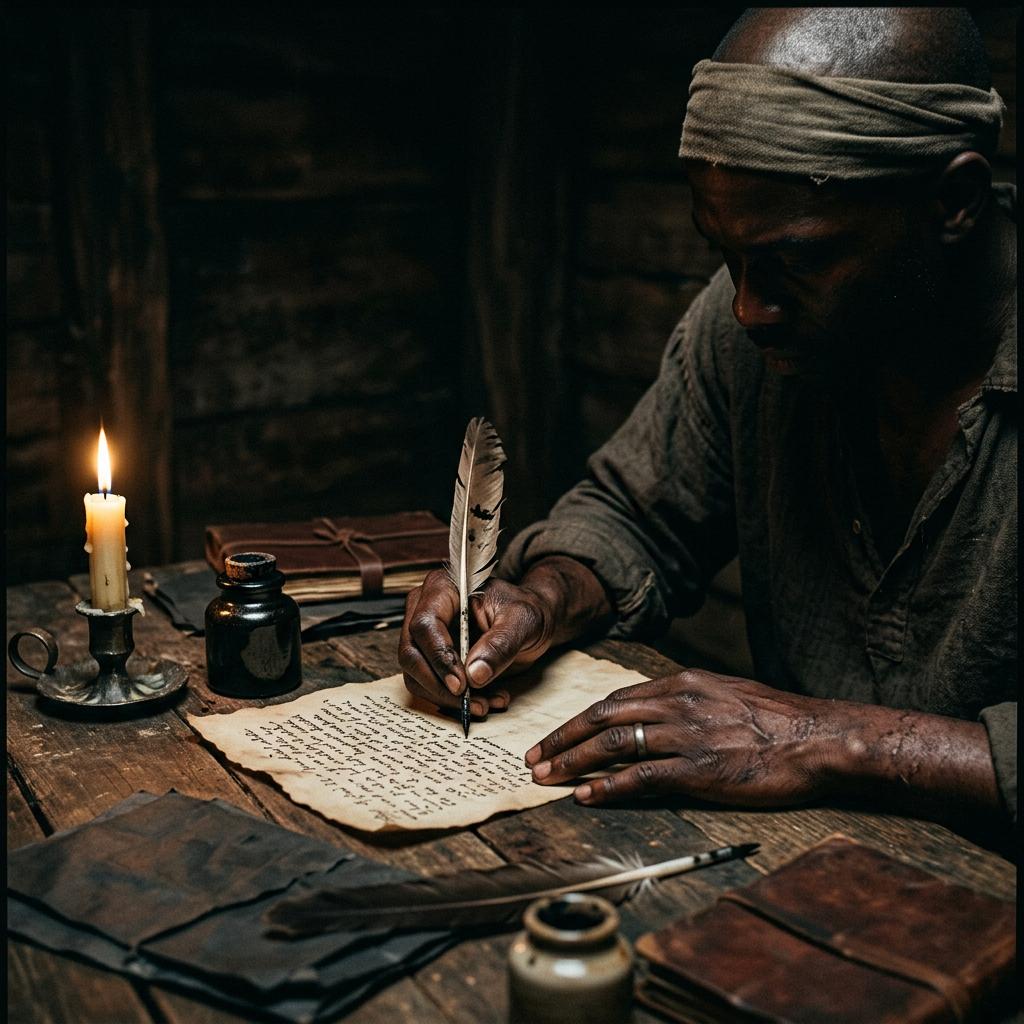
In 1740, an enslaved African man in Suriname did something extraordinary.
He picked up a pen and wrote to the people who owned him.
He wasn’t asking for better treatment.
He wasn’t asking for more food.
He was asking for something far more dangerous:
His freedom.
His name was Kwaku.
And unlike many enslaved Africans whose stories were erased, fragments of Kwaku’s story survived in the archives of colonial Suriname.
Kwaku was enslaved by the Society of Suriname, the organization that controlled much of the Dutch colony. He worked as a cook for the colonial government in Paramaribo.
Somewhere along the way, Kwaku learned to read and write.
He also became a Christian.
And those two things would change his life.
A CHRISTIAN IN BONDAGE
Kwaku began to see a contradiction.
He had become a Christian, yet he remained enslaved.
In his eyes, Christianity represented freedom, morality and a new way of life. But the society around him considered him property.
So Kwaku appealed directly to the authorities.
On March 6, 1740, he wrote to the Directors of the Society of Suriname.
Then he wrote again on May 6.
Months passed.
Still, he wasn’t free.
So on February 10, 1741, Kwaku wrote again.
Three letters.
One demand.
Freedom.
His argument was not simply that slavery was cruel.
He presented himself as a faithful servant who had embraced Christianity and continued to serve the colonial government.
He wasn’t asking to abandon his responsibilities.
He wanted to live as a free Christian.
In one surviving description of his argument, Kwaku referred to his condition as “this sorrowful slavery.”
Imagine the significance of that moment.
An enslaved African man—legally considered property—was using the written language and bureaucracy of the colonial system to challenge the very status imposed upon him.
He wasn’t leading an army.
He wasn’t hiding in the forest.
He was fighting with words.
AND THEN SOMETHING CHANGED
Eventually, the authorities granted his request.
In 1741, the records indicate that Kwaku—identified in the colonial records as the government’s former cook—was granted his freedom.
He was subsequently known as:
Cornelis van Maarssen.
The enslaved man called Kwaku had become a free man.
But his story doesn’t end there.
A later population record from 1762 identifies a free resident named Cornelis van Maersen living in Suriname.
More than twenty years after his successful petition, the man who had once been enslaved was still recorded as free.
THE MAN BEHIND THE NAME
There is still much we don’t know about Kwaku.
We don’t know exactly where in Africa he was born.
We don’t know his original family name.
We don’t know how he first learned to read and write.
And we don’t know exactly what happened to him after the surviving records disappear.
But perhaps that’s what makes his story so powerful.
Because for a brief moment in the eighteenth century, an enslaved African man’s own voice broke through the colonial archive.
He wrote.
He waited.
He wrote again.
And eventually, the records stopped calling him a slave.
They called him Cornelis van Maarssen.
Kwaku’s story reminds us that resistance did not always look like rebellion.
Sometimes, resistance looked like a man sitting alone with a pen, staring at a blank page, and deciding that the people who controlled his life would have to hear him.
**He was enslaved.
Then he became literate.
Then he demanded freedom.
And in 1741, he got it.**
Leave a Reply