
By Jamahl Hokstam
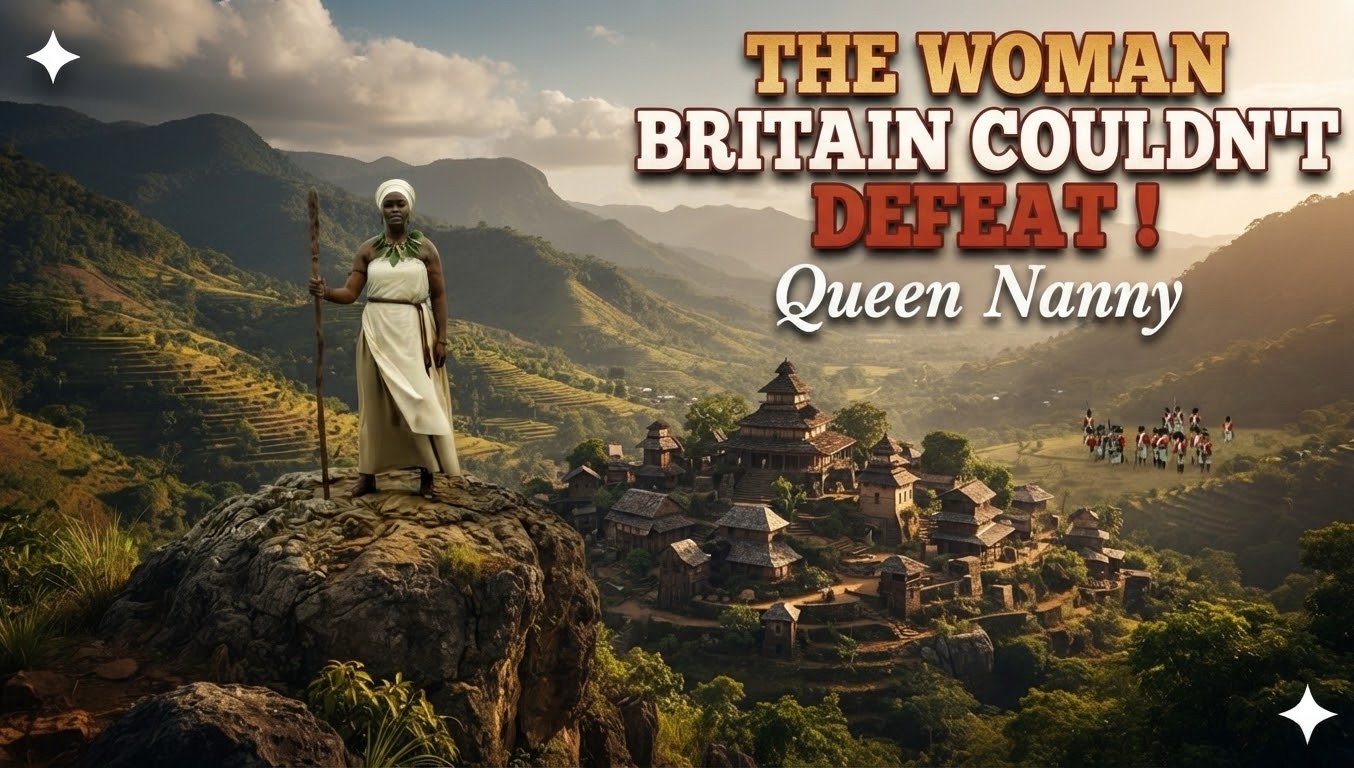
In the mountains of Jamaica, there was once a woman who built a community the British Empire could not easily conquer.
Her name was Queen Nanny of the Maroons.
And her weapon was not simply a gun or a sword.
It was strategy.
Nanny’s exact birthplace and date of birth remain uncertain. Jamaican tradition generally traces her origins to West Africa, particularly the Gold Coast, in present-day Ghana, and often connects her to the Akan or Ashanti people.
What we know is that she lived during one of the most brutal periods of Jamaican history—a time when Africans were being forced into slavery to build the wealth of the British plantation economy.
But some refused to accept that life.
They escaped into Jamaica’s mountains.
These people became known as the Maroons.
And Nanny would become one of their most important leaders.
Little is known about her childhood, but Maroon tradition remembers her as a woman deeply connected to African culture, spirituality, and community.
Eventually, she emerged as a leader of the Windward Maroons in eastern Jamaica.
Her greatest opportunity was the land itself.
The Jamaican mountains were rugged, dense, and difficult to navigate.
Nanny understood something the British struggled to understand:
The environment could become a weapon.
Instead of fighting the British on their terms, she made them fight on hers.
Her forces relied on ambushes, mobility, camouflage, surprise, and an intimate knowledge of the terrain.
They could strike—and disappear into the mountains before British forces could respond.
But Nanny’s greatest strength may not have been military at all.
She understood that a revolution needs more than fighters.
It needs a community.
Nanny helped build a society where escaped Africans could live outside the control of the plantation system, preserve their culture, and defend their freedom.
Her settlement, Nanny Town, became a major center of Maroon resistance.
But the British were determined to destroy it.
They had more soldiers.
More weapons.
More money.
And an entire colonial system behind them.
Nanny’s people had fewer resources, and their communities could be vulnerable to attack, betrayal, and internal divisions.
And eventually, the British captured Nanny Town in 1734.
But they had made a critical mistake.
They had captured a settlement.
They had not captured the movement.
The Maroons continued fighting.
Their resistance became so difficult to suppress that the British eventually turned to negotiation.
The First Maroon War ended with treaties recognizing Maroon communities and granting them land and a degree of independence.
Nanny’s exact role in the negotiations remains debated, and many stories surrounding her—including accounts of extraordinary spiritual powers—come from Maroon oral tradition rather than independently documented records.
But the impact of her leadership is undeniable.
Her people survived.
Their culture survived.
And their independence became part of Jamaica’s history.
Centuries later, Jamaica honored Nanny as a National Hero—the country’s only woman among its seven officially recognized National Heroes.
Her face has appeared on Jamaica’s $500 note.
But her greatest legacy isn’t the currency.
It’s the example.
Queen Nanny proved that power isn’t always measured by the size of an army.
The fact is
Sometimes power comes from knowing your environment.
Knowing your people.
Adapting when you’re outmatched.
And refusing to surrender your freedom.
The British had an empire.
Nanny had a mountain.
And for years, the mountain won.
That was Queen Nanny.
A woman who transformed resistance into survival—and survival into freedom.

Leave a Reply