
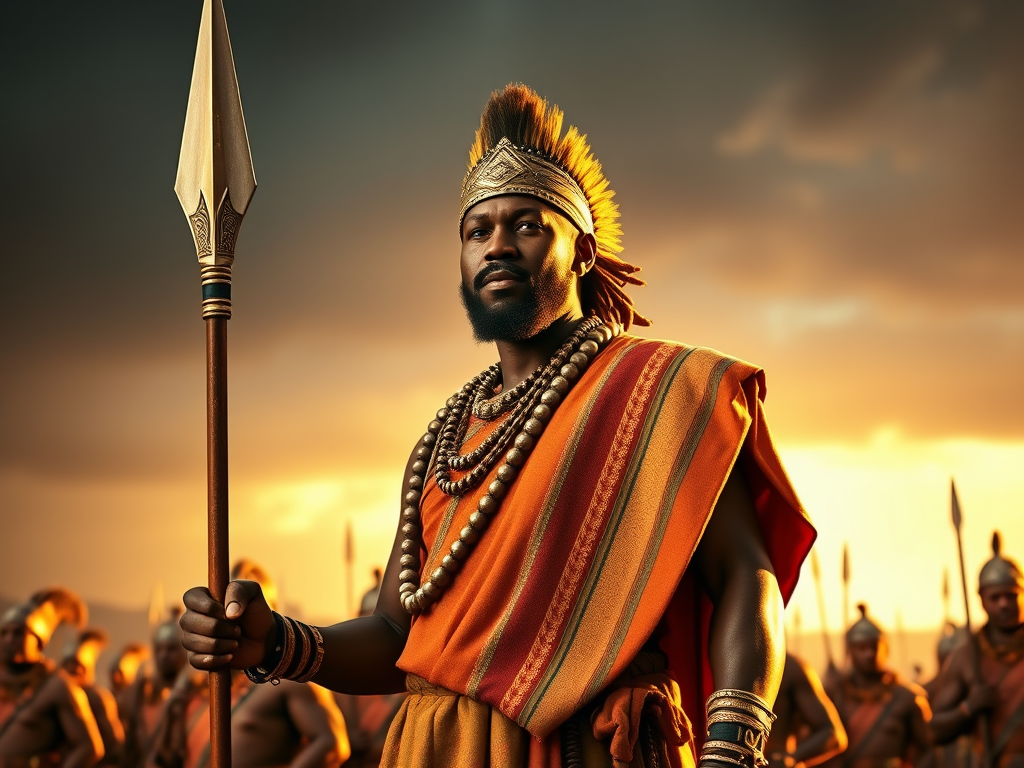
History has a habit of simplifying powerful people—especially when they didn’t fit neatly into European narratives. Shaka Zulu is often remembered as a ruthless warlord, a violent tyrant whose reign brought chaos to southern Africa. But that version of Shaka says less about the man himself and more about who was writing the story.
Shaka was not born into power. Born around 1787, he grew up marginalized and exiled with his mother, Nandi. That early rejection shaped him. Instead of inheriting authority, Shaka learned discipline and survival the hard way—skills that would later define his leadership.
When he entered the service of the Mthethwa Confederation under Chief Dingiswayo, Shaka’s talent became impossible to ignore. He studied warfare, organization, and loyalty. By the time he rose to lead the Zulu, he wasn’t just stepping into a throne—he was building a nation from fractured clans.
Shaka revolutionized warfare in the region. He replaced long throwing spears with the short stabbing spear, the iklwa, forcing decisive close combat. He introduced strict discipline, age-based regiments, and the famous “bull horn” formation, a tactic so effective it is still studied today. These changes weren’t acts of senseless violence—they were strategic responses to an already unstable and competitive landscape.

Much of Shaka’s reputation as a “bloodthirsty tyrant” comes from colonial-era accounts, written decades later by outsiders with political motives. These narratives often exaggerated his brutality while ignoring the widespread conflict already present across southern Africa—and the violence introduced by European expansion.
Shaka did not simply destroy rival groups. He often absorbed them, integrating conquered peoples into the Zulu state. His aim was consolidation and survival, not chaos.
Shaka ruled for just over a decade before being assassinated in 1828, yet his impact far outlived his reign. The Zulu Kingdom he built would later shock the world by defeating British forces at the Battle of Isandlwana in 1879, shattering the myth of European military invincibility.
Shaka Zulu matters because he forces us to question history itself. Who is remembered as “great,” and who is labeled “savage”? And how many stories were shaped by power rather than truth?
Understanding Shaka isn’t about rewriting history—it’s about finally reading it in full.
