
By Jamahl Hokstam
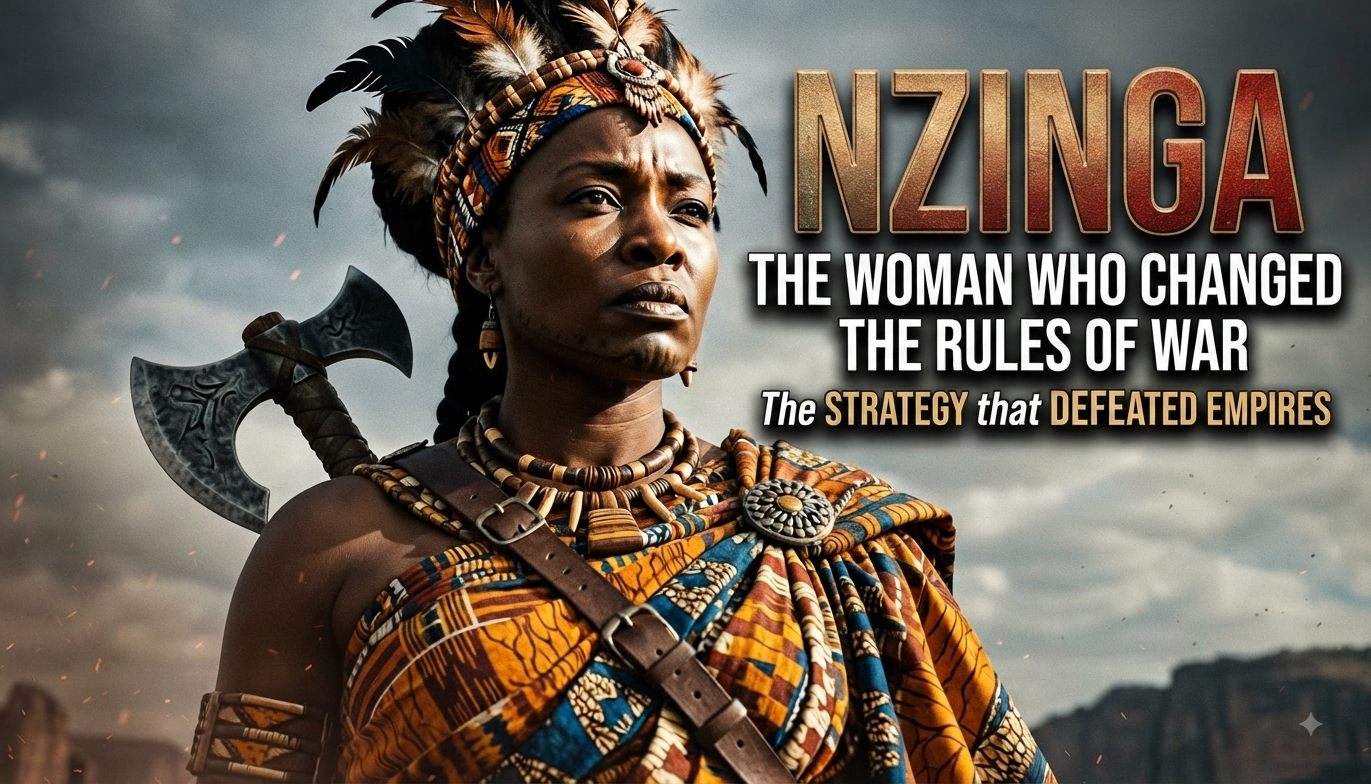
Nzinga of Ndongo: The Queen Who Turned War Into Strategy
Before modern warfare had names for it—guerrilla tactics, psychological operations, alliance politics—Queen Nzinga of Ndongo and Matamba was already executing all of it.
In the early 1600s, Portuguese forces pushed deep into Central Africa, hunting land, power, and people for the slave trade. Many kingdoms folded under pressure. Nzinga did the opposite. She studied the enemy, rewrote the rules, and turned resistance into an art form.
This wasn’t brute-force rebellion. This was calculated warfare. Winning the Mind Before the Battlefield. Nzinga understood something empires often forget: power starts in perception.

During a high-stakes negotiation in 1622, Portuguese officials attempted to humble her by offering no chair—forcing her to sit on the floor. Nzinga refused. She ordered an attendant to kneel and used their back as her seat, meeting the Europeans at eye level.
It was a silent declaration of dominance. Before a single shot was fired, Nzinga had already seized psychological ground.
Alliances as Weapons
Where others relied on loyalty, Nzinga relied on leverage.
She formed alliances when it suited her—and broke them just as efficiently. At times she negotiated with the Portuguese, only to later side with the Dutch when the balance of power shifted. She united rival groups, absorbed escaped slaves into her ranks, and built a mobile, diverse fighting force with nothing to lose.
Every relationship was strategic. Nothing was sentimental.
Guerrilla Warfare Before the Textbooks
Nzinga never tried to outgun the Portuguese. She didn’t need to.
Her forces attacked supply lines, raided slave outposts, and vanished into terrain European troops couldn’t navigate. Rather than defending fixed territory, Nzinga prioritized movement. She relocated capitals, split her forces, and refused to fight on her enemy’s terms.
The land became her shield. Speed became her advantage.
War as Nation-Building
Nzinga’s greatest strategy wasn’t just survival—it was construction.
She offered freedom to the enslaved, status to the loyal, and purpose to the displaced. Her army became a society, bound not by blood but by resistance. Long after the Portuguese expected her to fall, Nzinga remained a constant force—adapting, expanding, enduring.
When she died in 1663, she left behind more than victories. She left a blueprint for resistance.
Why Nzinga Still Matters
Nzinga of Ndongo proves that strategy can overpower empire. That intelligence can neutralize firepower. That adaptability is the ultimate form of strength.
She didn’t just fight colonialism.
She outthought it.
And that’s why, centuries later, her war strategy still hits different.
