
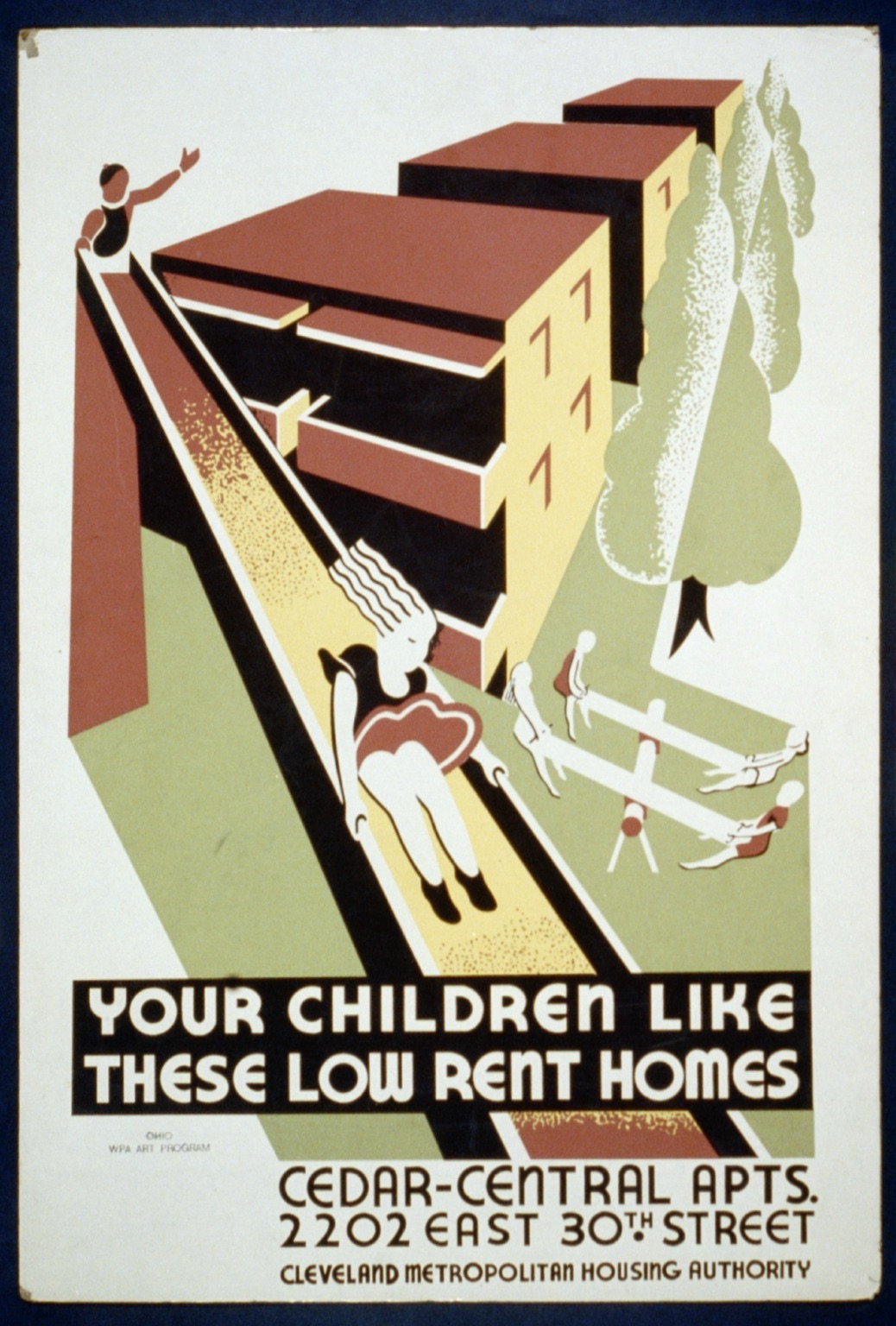
Low-income housing in the United States was initially designed for white, working-class families, particularly during the New Deal era. When public housing first emerged under the Housing Act of 1937, its primary goal was to provide temporary relief for white families struggling during the Great Depression. The government framed public housing as a stepping stone to homeownership, helping white workers transition out of slums and into stable housing while maintaining racial segregation.
During and after World War II, public housing continued to prioritize white veterans and working-class families. Meanwhile, Black families, who had also served in the war and contributed to the economy, faced discrimination in public housing access. When federal housing policies later encouraged homeownership through programs like the GI Bill and FHA-backed loans, these benefits were disproportionately given to white families, while Black families were systematically redlined and denied access to suburban housing.
The history of low-income housing in the United States is deeply rooted in racial discrimination and segregation. Even as public housing programs expanded, they were often designed in ways that reinforced racial inequalities rather than alleviating them.
The Housing Act of 1937 and the Birth of Segregated Public Housing
Public housing in the U.S. began as part of the Housing Act of 1937, a New Deal-era program aimed at slum clearance and job creation. While framed as a progressive initiative, it was anything but race-neutral. The federal government enabled local authorities to enforce segregation in public housing, either through direct policies or by failing to intervene against racist practices.
One of the first federal public housing projects, Techwood Homes in Atlanta, Georgia, exemplifies these racist beginnings. Built in 1935 by the Public Works Administration (PWA), the project evicted hundreds of Black families to create a 604-unit, whites-only neighborhood. This was not an isolated incident—throughout the country, public housing was often built on land previously occupied by Black communities, displacing them while providing newly constructed homes exclusively for white residents.
At the same time, local Public Housing Agencies (PHAs), empowered by eminent domain, had the authority to determine where public housing was built. Predictably, PHAs ensured that housing for Black residents was either entirely absent or placed in already segregated, underdeveloped areas. This practice reinforced racial isolation and created the conditions for the concentrated poverty that persists in many urban areas today.
The Housing Act of 1949 and the Expansion of Segregated Housing
The Housing Act of 1949 marked a major expansion of public housing, increasing the number of PHAs and leading to the widespread construction of public housing projects. However, this expansion did little to address racial inequality. In fact, the federal government continued to facilitate segregation rather than dismantle it.
In 1954, the Supreme Court ruled in Brown v. Board of Education that racial segregation in schools was unconstitutional. But when civil rights advocates argued that the same principle should apply to housing, federal officials rejected this idea. Berchmans Fitzpatrick, General Counsel for the Housing and Home Finance Agency (HHFA), openly stated that the decision did not apply to housing. Just one year later, the Eisenhower administration ended policies that required Black and white communities to receive equal-quality housing. This decision allowed local housing authorities to continue steering resources toward white housing projects while neglecting Black ones.
As public housing production increased throughout the 1960s and 1970s, segregation remained deeply entrenched. A 1984 investigation by the Dallas Morning News surveyed 47 metropolitan areas and found that nearly all public housing tenants were segregated by race. White-designated housing projects had better amenities and were in safer neighborhoods, while Black and brown communities were relegated to poorly maintained, high-poverty areas.
The Fair Housing Act of 1968 and the Federal Retreat from Public Housing
The passage of the Fair Housing Act in 1968 was meant to end discrimination in housing. However, by then, the federal government had already begun withdrawing support for public housing altogether. In 1974, President Nixon imposed a moratorium on housing spending, halting any new construction of public housing. From that point forward, federal housing subsidies shifted away from direct public housing projects and toward housing vouchers, a system that provided financial assistance to low-income tenants but did nothing to address the underlying racial inequalities in housing access.
By reducing its role in public housing, the federal government allowed segregation to remain in place while providing only superficial solutions to housing discrimination. Many landlords refused to accept housing vouchers from Black and brown tenants, further limiting their access to safe and stable housing. The disinvestment in public housing over the following decades—along with the dismantling of rent control, urban renewal policies that displaced minority communities, and the rise of mass incarceration—only deepened the racial wealth gap.
The Lingering Effects of Racist Housing Policies
The racist origins of public housing continue to shape American cities today. Decades of segregation and disinvestment have left a lasting mark on Black and brown communities. Many public housing developments remain underfunded, poorly maintained, and concentrated in areas with fewer job opportunities, lower-performing schools, and higher crime rates—conditions that were deliberately engineered by racist housing policies in the 20th century.
Moreover, the stigma surrounding public housing is itself a product of these racist policies. While white families in the mid-20th century benefited from subsidized housing that helped them transition to homeownership, Black families were systematically denied the same opportunities. Instead, public housing became racialized and vilified, leading to further disinvestment and neglect.
Low-income housing in the United States has never been a neutral or purely economic issue—it has always been a racial one. From the earliest days of public housing, the federal government and local authorities have actively worked to suppress non-white communities through segregationist policies, displacement, and systemic neglect. While legal segregation has ended, the legacy of these racist policies continues to define the housing landscape today. Addressing this history is crucial to understanding the ongoing racial disparities in housing and ensuring that future policies work to dismantle, rather than reinforce, racial inequality.
